Thursday, May 31, 2012

A gardening we will go...

Yesterday was the day to plant the marigold seeds that our pen pals from New Orleans sent us.  We planted rows and rows of them on our school farm! We had to use what we had learned about measurement to help us plant our seeds.  Knowing our measurement vocabulary really helped us!


Mr. Koehn explained that we should plant the marigolds about 5 or 6 inches away from the grass so they would not get run over by the lawnmower this summer.

Brandon and Keller used the width of their hands to space the seeds while planting.


Ava and Madison carefully follow the directions on their seed packets.

Bryce and Quinn work together to plant their marigold seeds.

Jaykob, David and Rachel take a closer look at the marigold seeds their pen pals sent them.

Lexi and Tel cover up the seeds they planted.

Boy! Planting seeds is dirty work!

Really dirty work!
After we finished planting our seeds Mr. Koehn took us to the new greenhouse. We ran wild through it!

I LOVE this place!
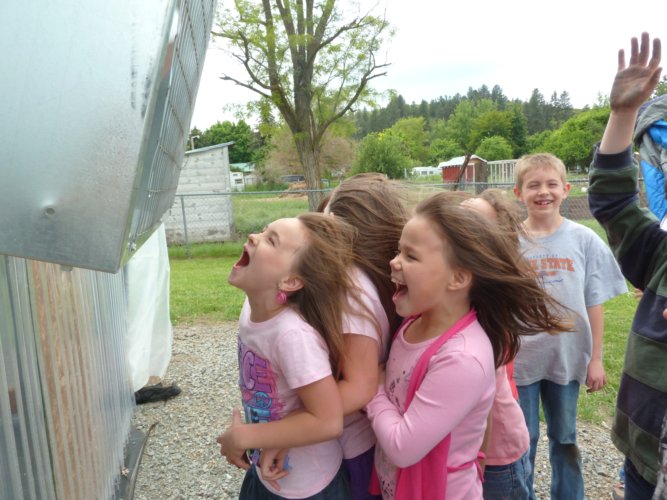
A few of us discovered the fan outside.  We felt like we were getting blown away!

Do you have a school farm or garden?  If so, what kinds of plants do you grow?


Wednesday, May 30, 2012

Experimental Poetry

Yesterday we tried our hand at some "experimental poetry."   At first we tried following an outline to write a poem about using our senses.  Here are some samples of this type of poem...


Camping


I hear crickets at night.
I see fish in a river.
I smell fish.
I taste food.
I touched a fish.


By: Bryce


Sweet Strawberries


I hear that there are sweet strawberries.
I see sweet strawberries.
I smell sweet strawberries.
I taste sweet strawberries and they taste good.
I touch the small plant that grew those sweet strawberries.


By: Rachel


The Storm


I hear whispering wind.
I see clouds of dust.
I smell fresh air.
I taste the wet rain.
I touch the dust in the air.


By: Ava


Then we tried starting every line the same way: I like, I wish, I am, etc... After the poem was finished we took the first part away...


I wish I was a ghost.
I wish we went to the store.
I wish I rode a horse all by myself.


Now remove the I wish...


I Wish


I was a ghost.
We went to the store.
I rode a horse all by myself.


By: Madison


I wish I could fly.
I wish I could go all around the world.
I wish I was rich.
I wish the sun was shining.
I wish I could do anything I wanted.


Now remove the I wish...


The Dream


I could fly.
I could go all around the world.
I was rich.
The sun was shining.
I could do anything I wanted!


By: Cove Second Grade

Monday, April 30, 2012


Did you know that April was National Poetry Month???  Well, we missed that boat because we were working diligently on our personal narratives and couldn't bring ourselves to put them aside to join in the celebration.  Sometimes you just have to move to the beat of your own drum and ours wasn't "beating" poetry last month.  However, this month our focus will be on Poetry.   All month long we will be reading and writing poetry. The first blog our teacher fell head over heals for was The Poem Farm, written by the talented Amy Ludwig Vanderwater.  She writes the BEST poetry for kids EVER! We will visit her blog a lot and will also grab some of the great ideas shared on the Wonderopolis blog.  We will be participating in a Poetry Writing Challenge for the entire month and will wrap up our hard work with a Poetry Slam for our friends and family.  Tomorrow we will make our Poetry Journals and begin our adventure.  Stay tuned...we plan on posting a poem a day for you..written and read by various second grade poets!
Graphics by DJ Inkers


Wednesday, April 25, 2012

Personal Narratives

We have been talking A LOT about the writing process while working on personal narratives in our classroom this month.   This is what our writing process looked like during the production of our personal narrative stories.
1. Decide!  Look through your writing journal, Slice of Life Writer's Notebook or just simply think about something that really happened in your life.
2. Develop!  Develop your idea by drawing the beginning, middle and end of your story.
3. Begin! Record a video of yourself telling this story using GlogsterEDU.
4. Continue! Listen to your recording and write your story on paper.
5. Feedback! Work with your writing partner and use the "Questioning" strategy to get more detail into your story.
6. Continue! Study the leads of other narrative stories.  Make sure yours is an attention grabber!
7. Continue & Feedback! Study the satisfying endings of narrative stories:  Is your ending satisfying to your audience?  If not, make it satisfying!
8. Review! Re-read your narrative and make sure it makes sense to you!
9. Publish:  Use a storyboard planner to create the slides to tell your story digitally using Photo Story 3.
           -sketch the pictures for your slides.
           -cut out the text that you will read while each slide plays.
           -create your own pictures or bring photographs for each slide.


Here is a completed personal narrative story by one of our second graders!


Monday, April 16, 2012

Scientific Method

We are learning about the Scientific Method in second grade!  We have learned that only things you can study with your senses (sight, smell, hearing, touch and taste) can be studied scientifically.  Our latest experiment involved raw eggs, vinegar and temperature changes.


What will happen to a raw egg submerged in vinegar?
The vinegar will dissolve the eggshell.


    Control Group 1: 1 raw egg, 1 cup vinegar, room temperature.
    Control Group 2: 1 raw egg, 1 cup vinegar, refrigerated.

(24 Hours)

The refrigerated egg appeared to be dissolving more quickly.  The vinegar was "foamier" at the top and the egg felt more "rubbery" than the egg left at room temperature.  However, we could see a small yellowish hole in the egg that was left at room temperature.  Both eggs had a large amount of small air bubbles on their shells.


(48 hours)

After 48 hours there was little foam in either jar.  Both eggs had distinct yellow spots on them.  Both eggs felt rubbery to the touch and their shells had dissolved a great deal.


 Vinegar dissolves the shell of an egg!


You can visit the Accidental Scientist here to find out why this works.  In a nutshell, vinegar is an acid that reacts with a base (calcium carbonate, which the eggshell is mostly made of) to dissolve the eggshell. The small bubbles on the egg is carbon dioxide being released from the shell.  There are other fun "egg" experiments you could try at the Accidental Scientist so check it out!


Thursday, April 5, 2012

Peep Attack!

Here is what our Peeps looked like after 4 days in their solvents!  Scroll to the bottom to see what we thought about our results.

Our Peep results are in this order: Mountain Dew, water, vegetable oil, vinegar and tomato juice.
Tomato Juice
Vinegar
Mountain Dew and Water
We were surprised the pink Peep turned yellow in the Mountain Dew!

Here are some of the observations scientists from our "lab" had on the fourth and final day of our experiment.

Madison was surprised that the Peep in the vegetable oil stayed pretty much the same.

David thought it was interesting that the Peep in vegetable oil dried up.

Rachel and Brandon were surprised that the peep in the vegetable oil was hard.

Brandon thought the Peep in the Mountain Dew felt like a slug.

Rylee and Ava thought it was cool that the vinegar Peep was almost all the way dissolved after four days.

David also thought the vinegar Peep felt like Jell-o.
.
We all concluded that vinegar was the best solvent.


Weekly Reflections

Each week we write a letter to our parents sharing about our learning and behavior.  Classroom photographer's take photographs all week to help spark our memories while we are writing.