Showing posts with label science. Show all posts

Wednesday, October 22, 2014

Sand! Comparing and Contrasting Pacific and Atlantic Sand

Today we have been comparing and contrasting sand from the Atlantic and Pacific Oceans.  We observed each specimen with the naked eye, by touch and beneath a microscope.  Here are some of the things we noticed:

Pacific Sand is:

-fine
-colorful: yellow, orange, red, silver-gray and clear grains
-sparkly
-hard
-sticky
    
Atlantic Sand is:

-coarse
-hard
-colorful: gold, red, dark brown, orange, gray and clear grains
-sticky
-sparkly

We give looking at sand under a microscope two thumbs up!

S.D. discovers that a book he was reading had a picture that looked similar to what he was seeing under the microscope.

Second grader's feel the difference between Atlantic and Pacific Ocean sand.


Wednesday, April 9, 2014

Dinosaurs!

We are currently working on creating a question and answer book about dinosaurs through guided research. Today we will try to find answers to the questions we have collected from our reading.  We will be using some really fun iPad apps as well as these websites here!

Create your own Playlist on LessonPaths!

Thursday, May 30, 2013

Science Party

Yesterday we had a Space Party and did lots of fun Space activities.  We all got in a spacesuit that our teacher made out of a cardboard box.  We thought it was exciting!  There were five other stations too.  Our favorite station was making Atomic Slime Goo that glows in the dark!  We made the slime glow by using a black light.  We lit up too!  One of our other favorite stations was making Moon Sand and playing with it.  We made moon sand castles and it was very, very fun and interesting.  We hope you enjoy our video!

Monday, May 6, 2013

Impact Crater Discovery

Today in science we were exploring the idea of impact craters.  We were trying to figure out how velocity (speed), angle of impact and size & shape of an impactor (meteorite, asteroid) effected the size and shape of an impact crater.

Jakob, Justin, Jaden and David discovered that not all impactors created the same size crater. The large, not solid, baseball they used created a shallow crater. They thought that if the baseball was solid it would probably make a deeper crater.


Tanner, Taylor, Greyson and Terrell noticed that the faster the impactor was thrown the more central uplift they got. In addition to this they discovered that not all central uplifts were big. They also noticed that when you throw small impactors fast (high velocity) you get big craters.


Collin, Kami, Lydia and Falisha figured out that if you throw a small impactor slow (without much velocity) you get a small crater and if you throw the same impactor faster (increase the velocity) you get a bigger crater.  


Tomorrow we will continue our research and analyze our data.

Wednesday, April 3, 2013

Geometry and Space!

This week we have begun studying Geometry and Space! We wrote letters to martians explaining what a triangle is. We learned about the Solar System and galaxies using the Kids Discover Galaxies App and studied oi/oy words, taking pictures and writing complete sentences defining some of those words. We also worked hard to try and recreate the rocket our teacher made using one square of paper cut into four pieces. It was tricky!


Thursday, March 21, 2013

Weather Watchers

For the past week we have been watching the weather around the world. Each group chose a city on one of 6 continents; North America, South America, Africa, Europe, Asia and Australia. We checked the weather each day using the Weather+ App on our iPads and recorded the high and low temperatures as well as the weather conditions. At the end of the week we used the data we collected about our cities to make line graphs.


Saturday, March 2, 2013

Water Cycle in the Bag

Last week we observed the water cycle in action. We used zip-lock bags to create mini water cycle environments. Each morning we observed what was happening inside our controlled environment. Condensation formed inside our bags and we noticed cloud-like fog on the inside of our bags. Some of us realized that we see the water cycle occurring in our very own homes when we take a hot shower in a cool bathroom!


Wednesday, February 27, 2013

Weather Words in the Hall

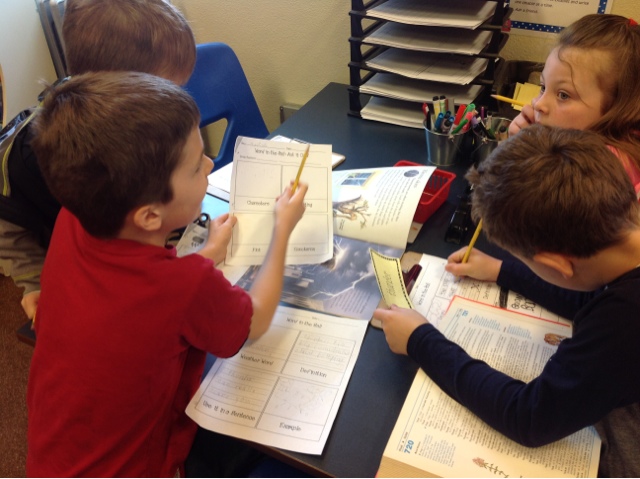
Today we began working on our Weather Words in the Hall video projects. Each group chose a weather word, looked up its definition, used the word in a sentence and brainstormed a list of examples that would help explain what the word meant. Tomorrow we will make a plan for acting out our words and work together to create short videos using the Splice app on our iPads.


Friday, February 22, 2013

Building Our Vocabulary with Weather Words!

This week we were busy building a Weather Glossary in our classroom. As we learned about the water cycle we created pictures to help us remember new and important vocabulary.

We created visuals to represent the processes in the water cycle.
One of our classmates drew a picture to show us what a blizzard might look like.
This diagram shows how water evaporates.

Friday, February 15, 2013

Tornado in a Jar Conclusions

This morning we experimented more with our tornadoes in a jar and shared our observations. We concluded that you make the best tornado by shaking the jar back and forth, side to side.  Not to fast, not to slow.

If you want to try this experiment at home all you need is a clean jar, water and dish soap. 


Tuesday, February 12, 2013

Tornado in a Jar!


Today we learned about tornadoes.  Did you know that there is no other force in nature that is more destructive?  We used the scientific method as we experimented with a glass jar, water and dish soap to see if we could create mini tornadoes with our science buddies.


Tomorrow we will discuss our observations and share our conclusions.  Stay tuned!

Sunday, November 4, 2012

Boo Bubbles

On Halloween we were introduced to the Scientific Method with a science experiment masterminded by Steve Spangler.  You can click here to watch a video of Steve doing this experiment.

Mrs. Williams set out all of the supplies we needed to do the experiment and explained that scientists use a process called the scientific method.  She said the first step in this process was to ask questions.  Our question was:

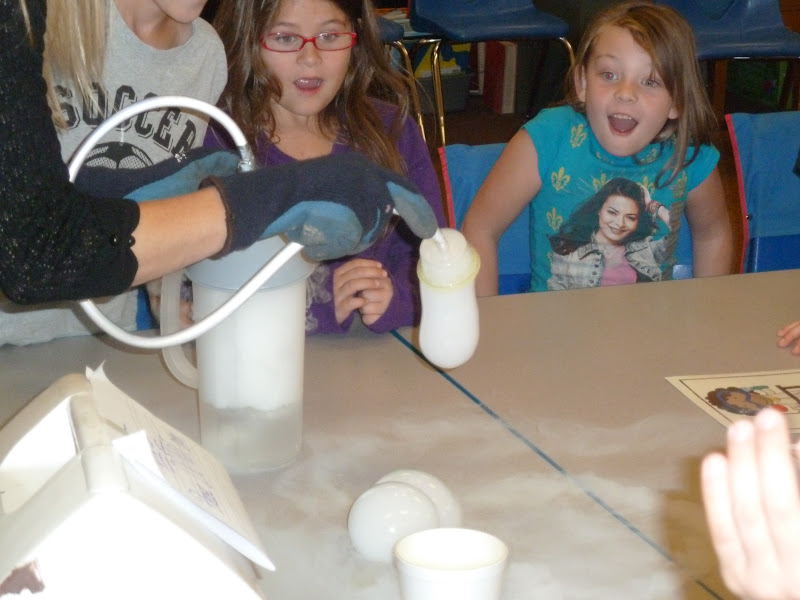
What would happen if we placed dry ice into warm water, capped the container with our funnel/tube/cup apparatus and dipped the small 2 oz. cup at the end of the tube into a soap solution?


We then talked with our neighbors and made predictions about what we thought would happen.  We then used our predictions to form a Hypothesis, which is the second step in the scientific process.

Next we had to test our Hypothesis, the third step in the scientific process.  Here is what happened!


We made LOTS of observations, the fourth step in the scientific process, and all had a chance to play with the Boo Bubbles.  

The final step was to draw conclusions.  We concluded that when you put the carbon dioxide, in its solid form, into warm water it immediately transforms into its gaseous form and if you control the amount of gas that is released (by only letting it escape through a tiny tube) it creates pressure that blows the gas into a bubble.  

We LOVED this experiment and can't wait to make more scientific discoveries throughout the year!


Tuesday, June 19, 2012

Nature Scavenger Hunt

My Sons and I have been spending a lot of time in our backyard observing the two young chicks Eli brought home from Kindergarten this spring.  As I was sitting out in the sunshine watching them yesterday I realized there was a lot going on around me!  In that small space I saw a turquoise beetle (yes, turquoise!), beautiful blooming iris, an ant with only 5 legs, a birds nest I hadn't noticed before, shimmering green leaves on my neighbors aspen trees...and then my great idea hit!  Why not see what those sweet little scientists I know can find in their backyards!  And this is how the Nature Scavenger Hunt was born.  Of course, lots of people have created nature scavenger hunts before.  I have gone on many myself.  However, I can't say that I remember being asked to do one while sitting quietly in my backyard.  I hope you try it out and have as much fun as I did.  Please don't forget to share all of the interesting things you find with us.

Nature Scavenger Hunt